
Horse Racing Going and Turf Conditions
 Available in US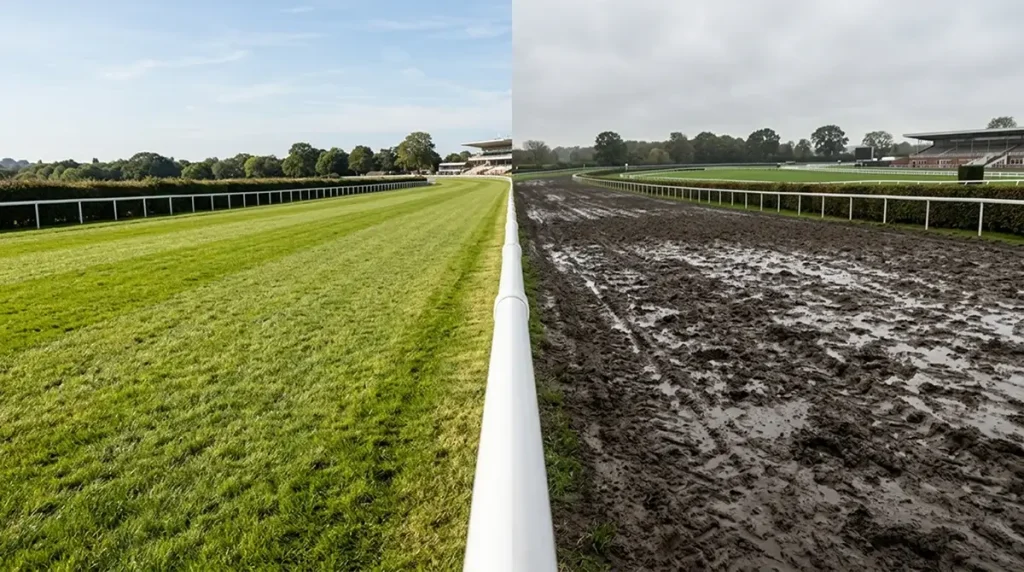
I once backed a horse at Haydock on what was advertised as good-to-soft ground. By the time the rain cleared and the race went off two hours later, the going had changed to heavy. My selection — a quick-ground specialist with a devastating turn of foot — ran like it was wading through treacle and finished last. The form had been impeccable. The going killed the bet. That was the day I learned that ground conditions are not background information on a racecard — they are the single most variable factor in any UK race, and ignoring them costs more money than any other mistake.
British racing is unique in the world because the weather makes every meeting different. In Australia or the US, most major racing happens on consistent surfaces — dirt or synthetic tracks with predictable characteristics. In the UK, turf racing means the ground changes with every rain shower, dry spell, and frost. The going can shift between the morning inspection and the first race, and between the first race and the last. Understanding the scale, the measurement, and the impact on different horses is foundational to any serious approach.
Official Ground Condition Scale Evaluated
The official going descriptions in the UK follow a standardised scale, though the reality on the ground is always more nuanced than a single word can capture.
At the fast end: hard and firm. Hard ground is rare in UK racing and most meetings will be abandoned rather than run on genuinely hard ground due to injury risk. Firm is the fastest surface — the turf is dry, the ground is compact, and horses with a low, economical action thrive. Speed horses, front-runners, and horses with a quick turn of foot tend to perform best on firm ground because the surface offers maximum traction with minimal resistance.
Good to firm is the most common going description during the flat season from May through September. The ground has some moisture but is still on the quick side. Most horses handle good to firm, which is why fields tend to be largest and most competitive on this going — fewer runners are pulled out due to ground preferences.
Good is the official description of ideal conditions — neither fast nor slow. In practice, “good” covers a wide band and can lean toward the quicker or slower side depending on the course and the weather in the preceding days. Clerks of the course sometimes describe the going as “good, good to firm in places” to signal the variation across different parts of the track.
Good to soft marks the transition into winter ground. The turf has taken on enough moisture to slow the surface noticeably, and horses with stamina and a higher action start to gain an advantage over speed specialists. Good to soft is the default going for most National Hunt racing between October and March.
Soft ground is properly testing. The turf cuts up under hooves, energy expenditure increases significantly, and races tend to be run at a slower pace with a greater emphasis on stamina and jumping accuracy. Horses bred for speed on the flat often struggle on soft ground because their physiology is not designed for the extra effort required.
Heavy is the extreme. The ground is waterlogged, every stride requires maximum effort, and races frequently produce shock results because the conditions neutralise class differences. A quality horse rated 20 pounds above the rest of the field on good ground might be beaten on heavy ground by a plodder who simply handles the mud better. The number of high-class horses on the flat — those rated 90 or above — reached 1,423 in 2025, but on heavy ground, that rating means less than the horse’s pedigree and physical aptitude for the conditions.
Going Stick Readings and How Clerks Assess the Ground
The going stick is a penetrometer — a metal probe pushed into the turf at multiple points around the course to measure the ground’s resistance. Readings are taken at standardised locations and averaged to produce a numerical going figure that supplements the verbal description.
Going stick readings range from around 3.0 on heavy ground to 13.0 or above on firm. The scale is not linear in its impact on racing — the difference between a 6.0 and a 7.0 reading (good to soft versus good) has less practical effect than the difference between a 4.0 and a 5.0 (soft versus good to soft). The lower end of the scale is where conditions change most dramatically and where form analysis is most disrupted.
Clerks of the course take readings at multiple times during the day and may officially change the going between races if conditions shift — typically due to rain or sustained sunshine drying out the track. Watering is also a factor: many courses water the track in dry spells to maintain safe ground, and the amount and timing of watering can create localised variations. The stands’ side of a straight course might ride faster than the far side because of differential drainage or shade patterns.
I check the going stick readings on the morning of every meeting I bet on. The verbal description is useful but imprecise. A course described as “good to soft” might read 5.8 on the going stick one morning and 6.4 the next after overnight drainage. That difference is the gap between a surface that genuinely tests stamina and one that is closer to good than the label suggests.
How Going Conditions Influence Odds and Selections
The market adjusts to going changes, but it adjusts slowly and imperfectly. This is where informed punters find edges.
When the going changes from the forecast description — say, an unexpected downpour turning good ground to soft an hour before the first race — the immediate market reaction tends to be modest. Bookmakers revise prices on the most obvious ground specialists, but the middle of the market stays largely intact. A horse with no clear going preference might not move at all, even though its chance has objectively changed based on the new conditions.
I use a simple filter: before looking at form, I check the going and eliminate any horse with a documented aversion to the surface. A horse whose form reads “won three on good, unplaced twice on soft” is a different animal depending on whether the ground is good or soft. If the going is soft, that horse goes off my list regardless of its overall ability. Alan Delmonte, HBLB chief executive, has noted that if racing is to remain a leading sport, it needs to be presented in a way that is attractive to the modern consumer. Part of that presentation, I would argue, is helping punters understand the factors — like going — that make each race genuinely different from the last.
The impact on odds is most pronounced in National Hunt racing, where ground conditions vary more dramatically than on the flat. A soft-ground specialist at 8/1 on good ground might shorten to 5/1 if overnight rain transforms the surface. If you have identified that horse in advance and taken the 8/1 before the going change, you hold a price that no longer reflects the true probability. That scenario plays out on dozens of meetings every season across UK racing.
All-weather surfaces — the polytrack and tapeta tracks at Kempton, Wolverhampton, Lingfield, Newcastle, and Chelmsford — eliminate going as a variable almost entirely. These synthetic surfaces are designed to perform consistently regardless of weather, which changes the form analysis equation. A horse’s all-weather form should be assessed separately from its turf form, because the two surfaces test different physical attributes. For a breakdown of how form figures capture all of these variables in a single line, the guide to racecard symbols and abbreviations covers the codes you need to decode.
What factors affect horse racing going conditions?
The primary factors are rainfall, temperature, wind, sunshine, drainage characteristics of the individual racecourse, and deliberate watering by the groundstaff. Courses on chalk drain faster than those on clay. Shaded areas of a track retain moisture longer than exposed sections. Going can change between the morning inspection and the afternoon races, which is why checking the latest going report and going stick readings close to race time is essential.
How do all-weather surfaces compare to turf going?
All-weather tracks use synthetic surfaces like polytrack or tapeta that are designed to provide consistent racing conditions regardless of the weather. They do not become firm or heavy the way turf does, which removes going as a variable. However, some horses perform markedly better on all-weather than on turf, and vice versa. Form on the two surface types should be assessed independently.
Articles
Prepared by the Betting Online Horse Racing editorial staff.
