
Online Horse Racing Betting Data and Odds
 Available in US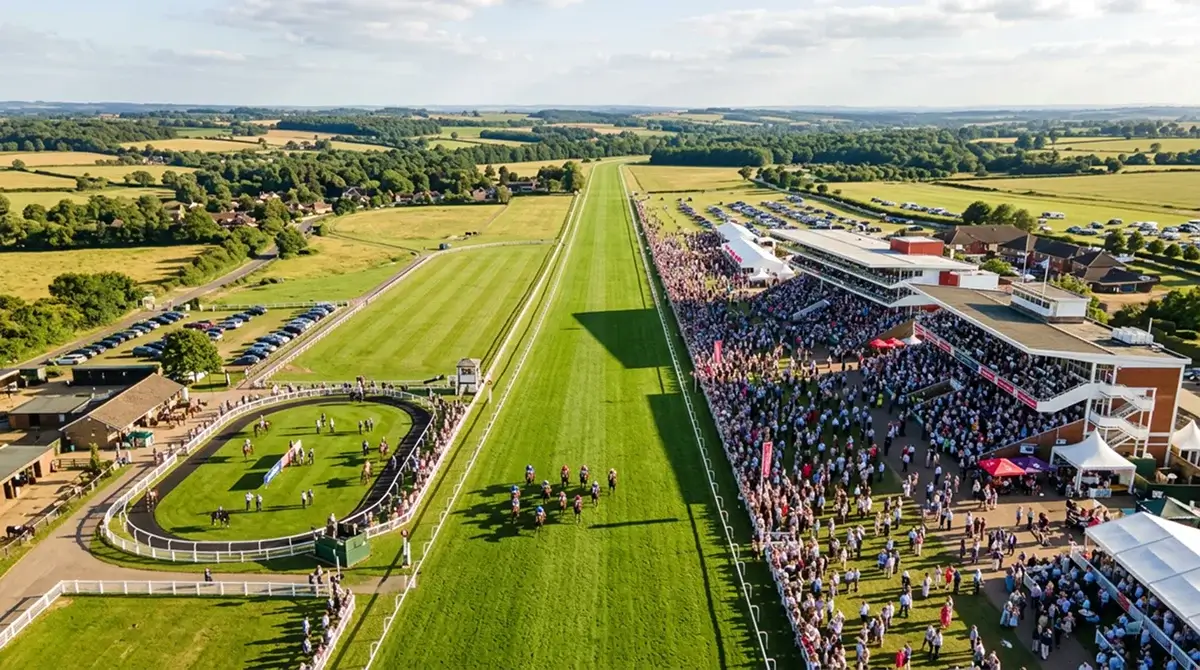
I placed my first horse racing bet in 2017, a fiver on a 12/1 shot at Newbury that came nowhere. What hooked me was not that bet but the hour I spent afterwards trying to understand why the odds moved from 14/1 to 12/1 in the final ten minutes before the off. Nine years later, I spend more time reading Gambling Commission reports and BHA racing data than I do watching actual races — and that shift from casual punter to market analyst is exactly what this guide is built around.
UK horse and sports betting industry value: £3.7 billion in 2026 — with 499 companies operating across the sector.
The UK horse racing betting landscape in 2026 is a market under tension. On one side, the industry generates enormous revenue — gross gambling yield from remote horse racing bets alone hit £766.7 million in the year to March 2025. On the other, betting turnover on British racing has been falling steadily, regulatory intervention is reshaping how punters interact with their accounts, and an unlicensed market is growing at a pace that should worry everyone involved.
Remote horse racing GGY: £766.7 million — April 2024 to March 2025, according to the UK Gambling Commission.
Most guides to online horse racing betting in the UK read like a catalogue of bookmaker bonuses with a paragraph on "bet responsibly" stapled to the end. This one does not. I have built it around the numbers — market data, regulatory filings, industry reports — because understanding where your money goes and how the ecosystem works makes you a sharper punter than any list of "top five bookmakers" ever will. Whether you are placing your first each-way bet or you have been backing horses for two decades, the sections ahead cover the full terrain: market structure, odds mechanics, bet types, regulation, the turnover crisis, and the emerging black market that threatens the sport's funding.
Core Statistics for UK Horse Racing Betting
- The UK betting industry is valued at £3.7 billion, yet horse racing turnover has fallen 12.8% in two years — a contraction driven by affordability checks, competition, and shifting demographics.
- Affordability checks trigger at £150 in net monthly deposits, affecting 23.7% of surveyed bettors and pushing volume toward unlicensed operators.
- Traffic to unlicensed betting sites surged 522% between 2021 and 2024, while licensed site traffic grew just 49%.
- Racecourse attendance hit 5.031 million in 2025, with betting participation peaking at 7% of adults during the April-to-July festival window.
- Understanding odds mechanics, bet-type maths, and bankroll discipline matters more than any bookmaker bonus — the overround ensures the house has a margin, and informed selection is your only counterweight.
How Big Is the UK Horse Racing Betting Market
A colleague once told me horse racing was "a dying sport propped up by old men in betting shops." I showed him a £3.7 billion industry with 499 active companies. The scale of the UK horse racing betting market catches people off guard because the cultural visibility of the sport has declined even as the financial infrastructure has grown more complex.
£3.7 billion — the estimated value of the UK horse and sports betting industry in 2026, encompassing 499 companies.
Globally, the online horse racing betting platform market was valued at USD 360 million in 2025, with projections pointing toward USD 504.2 million by 2033 at a compound annual growth rate of 4.3%. Europe holds the largest share — roughly 35% of the global market — while the Asia-Pacific region is expanding fastest at a CAGR of 5.0%. Within that European dominance, the UK sits at the centre. More than 120 licensed operators hold active permissions, and annual investment in platform development runs to approximately USD 150 million.
Global online horse racing platform market: USD 360 million in 2025 — projected to reach USD 504.2 million by 2033.
The UK leads the global horse racing betting platform market, with annual investment of around USD 150 million in platform development — more than any other single country.
The corporate side of this market is dominated by a handful of groups whose scale dwarfs everything else. Flutter Entertainment reported group revenue of $15.91 billion for 2025 — a 17% increase year-on-year — with adjusted EBITDA climbing 21% to $2.85 billion. Entain PLC posted net gaming revenue of £5.3 billion in the same period, with its UK online division recording volume growth of 15%. These are not niche businesses. They are multinational corporations, and the health of British horse racing is one variable among dozens in their quarterly earnings calls.
The headline numbers look healthy — remote betting GGY across all sports reached £2.6 billion in the year to March 2025 — but they mask a structural shift happening underneath. The UK Gambling Commission's Chief Executive has characterised recent trends as a return to the previous norm rather than a decline, noting that online betting follows the pattern of large marquee events. That framing has some truth, but it does not capture the full picture, as I will unpack in the sections on turnover decline and the growing black market.
Understanding market size is not academic. The bigger the market, the more operators compete for your stake, and competition drives better odds, more streaming coverage, and richer promotions. But it also attracts regulatory attention, and the tension between growth and oversight defines the current betting environment.
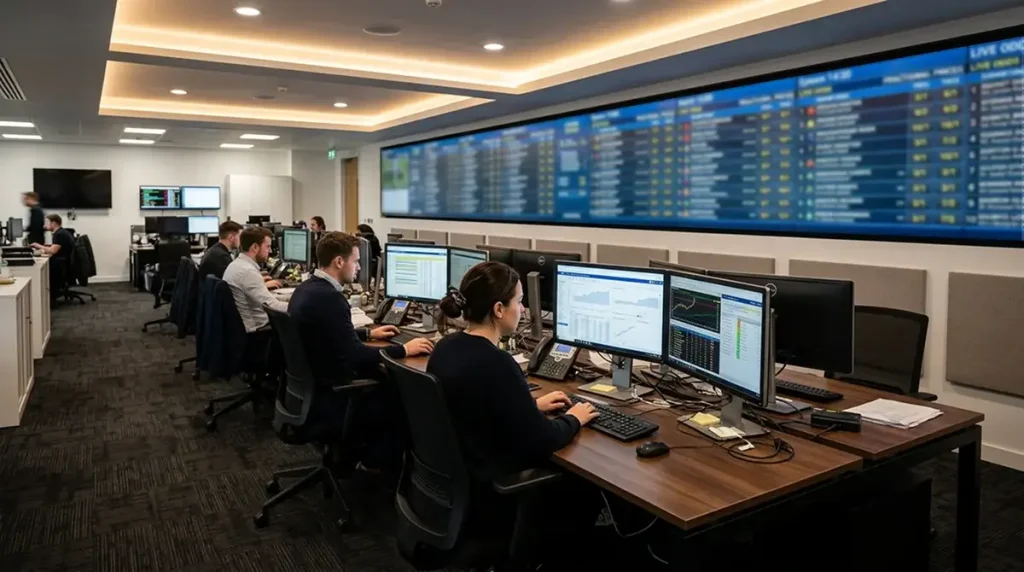
The market is vast and well-funded — but its mechanics start with something far simpler: the price attached to a horse. That is where every bet begins.
How Horse Racing Odds Work in Practice
The first time I looked at a racecard and saw "11/4" next to a horse's name, I had to google what it meant. That was embarrassing, given I had already placed three bets. I share that because most odds explanations assume you either know nothing or know everything — this section sits in the middle, where most real punters actually live.
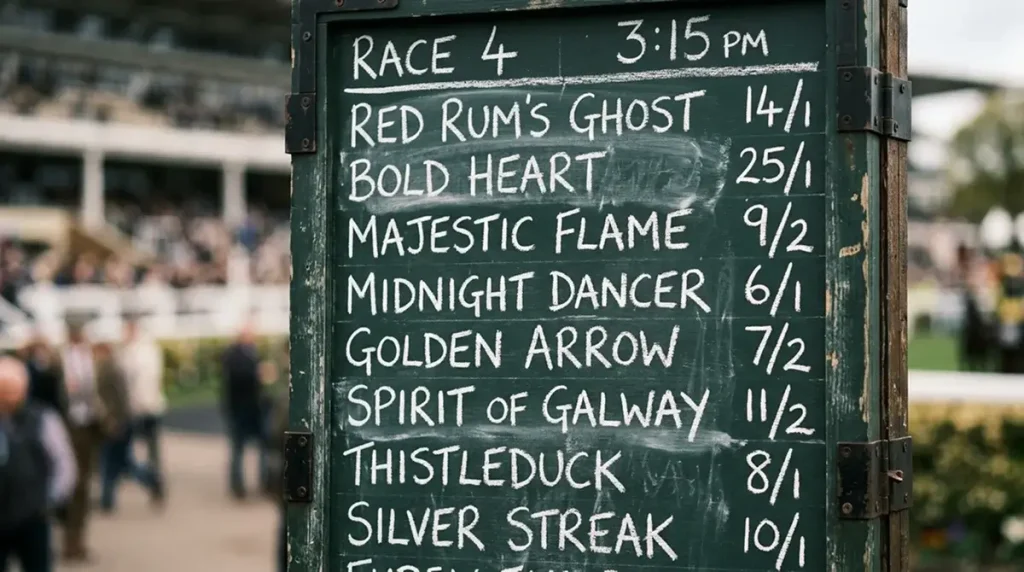
Fractional odds example: A horse priced at 5/1 returns £5 profit for every £1 staked, plus your original stake back. A £10 bet at 5/1 returns £60 total (£50 profit + £10 stake).
UK horse racing traditionally uses fractional odds — expressions like 5/1, 7/2, 11/4. The first number represents your potential profit relative to the second number, which represents your stake. So 7/2 means £7 profit for every £2 wagered, or £3.50 per pound. The beauty of fractional odds is intuitive scaling: double your stake, double your return. The problem is that comparing 11/4 with 15/8 in your head at speed is genuinely difficult, which is why many experienced punters quietly switch their accounts to decimal format.
Decimal odds express the total return per pound staked. A horse at 5/1 fractional becomes 6.00 decimal — £6 back for every £1, including your stake. The conversion: divide the first number by the second and add one. So 7/2 becomes 4.50. The advantage is speed — comparing 4.50 with 2.875 is far faster than comparing 7/2 with 15/8, especially when scanning a 16-runner handicap five minutes before the off.
Starting Price (SP) is the official odds of a horse at the moment the race begins. It is determined by on-course bookmakers and acts as the settlement price for any bet placed at SP. If you take an early price but your bookmaker offers Best Odds Guaranteed, you receive whichever is higher — your price or the SP.
Behind every set of odds sits a concept called implied probability. A horse at 4/1 (5.00 decimal) carries an implied probability of 20% — the market's estimate of its chance of winning. You calculate it by dividing 1 by the decimal odds: 1 / 5.00 = 0.20, or 20%. Where this gets interesting is the overround. If you add up the implied probabilities of every horse in a race, the total will exceed 100% — typically between 110% and 125% depending on the number of runners and the competitiveness of the market. That excess is the bookmaker's margin, built into every price.
Overround — the margin built into a book by a bookmaker, expressed as the percentage by which the sum of all implied probabilities exceeds 100%. A lower overround means better value for punters.
Average turnover per race on Premier Fixtures — the big-field, high-profile meetings — grew by 2.7% in 2025, while Core Fixtures saw per-race turnover fall by 8.6%. That gap tells you something important about how odds markets behave: competitive, well-attended events attract more money, which tightens the overround and sharpens the odds. Smaller fixtures with thin markets carry wider margins. If you want better prices, gravitate toward the meetings where liquidity is highest.
For a comprehensive breakdown of fractional versus decimal formats, starting price mechanics, implied probability calculations, and how bookmaker margins actually eat into your returns, I have written a dedicated piece on horse racing odds and what the numbers hide.
Core Bet Types Every Punter Should Know
I once watched a friend place an each-way bet on a three-runner race without realising the place terms collapsed to 1/4 odds for one place only. He backed the second-favourite, it finished second, and the return was so thin he thought the app had glitched. Knowing the mechanics of each bet type is not optional — it is the difference between a calculated risk and a costly misunderstanding.
The foundation is the Win bet: you back a horse to finish first. If it wins, you collect; if it does not, you lose your stake. There is nothing simpler in racing. The Place bet pays out if your horse finishes in the top two, three, or four depending on the number of runners and the type of race. Place-only bets carry shorter odds but offer more frequent returns, which is why they appeal to punters who value steadiness over big paydays.
Each-Way betting is effectively two bets in one: a Win bet and a Place bet, each for the same stake. If you place a £5 each-way bet, your total outlay is £10. If the horse wins, both parts pay out. If it places but does not win, only the place portion returns — typically at 1/4 or 1/5 of the win odds, depending on the number of runners and the bookmaker's terms.
Each-way is the bread and butter of UK horse racing betting, especially in large-field handicaps where backing a horse to win outright at 20/1 feels risky but the each-way terms give you four or five places at 1/4 odds. The trap is small fields. In races with five to seven runners, each-way terms tighten dramatically, and the place portion can return so little that it barely covers the combined stake.
Accumulators chain multiple selections across different races into a single bet. All selections must win for the bet to pay out, which is why the potential returns are large and the strike rate is low. A four-fold accumulator at average odds of 3/1 per leg returns a combined price of roughly 255/1 — thrilling on paper, brutal in practice. Accumulators work best as small-stake entertainment, not as a strategy. Doubles and trebles follow the same logic with fewer legs and better hit rates.
Forecasts and tricasts require you to predict the exact finishing order for the first two or three horses. A straight forecast on a 10-runner race can pay above 200/1 on competitive handicaps, but the precision required makes these inherently speculative. Reverse forecasts and combination tricasts expand coverage at the cost of higher stakes.
Placepot — a Tote pool bet requiring you to select a placed horse in each of the first six races at a meeting. Minimum stake is £1, and dividends can be substantial when favourites fail.
Beyond the standard wagers, specialist markets like the Placepot, Lucky 15, and named multiples (Yankee, Heinz, Goliath) offer different risk-reward profiles. The full breakdown of every bet type — including payout mechanics, worked examples, and guidance on matching bet type to race conditions — is available in its own dedicated guide. The key principle is straightforward: understand the maths of a bet before you place it, and never let a bookmaker's marketing convince you that complexity equals value.
What Separates a Good Racing Bookmaker from the Rest
I keep accounts with five different operators, and I use each one for a different reason. One has the best early prices on National Hunt. Another streams every UK meeting. A third consistently offers extra places on big handicaps. The idea that there is a single "best bookmaker" is a fiction peddled by affiliate sites — what matters is knowing what to evaluate and why.
UKGC Licence
Non-negotiable. Every operator you use must hold an active licence from the UK Gambling Commission. Verify it directly on the Commission's public register before depositing.
Odds Quality and BOG
Best Odds Guaranteed ensures you receive the higher of your taken price or the starting price. Not all operators offer it on all races.
Live Streaming Coverage
Some operators stream every UK and Irish meeting; others limit coverage. A funded account or a placed bet is usually required to access streams.
Racing-Specific Tools
Integrated racecards, form data, early prices, and ante-post markets. Generic sportsbooks often lack depth here.
Mobile Experience
Speed of bet placement, stream quality on mobile networks, and the ability to cash out mid-race all vary significantly between apps.
Licensing is the starting line, not a differentiator. With over 120 licensed operators in the UK market, holding a UKGC licence is the minimum standard, but it is one that matters absolutely. Unlicensed operators — and there are a growing number of them — offer no consumer protection, no dispute resolution, and no contribution to the racing economy. The number of licensed betting shops has fallen to 5,825 as of March 2025, a 36% decline over ten years, which means the online licence check is even more important as the high street disappears and the digital marketplace expands.
Odds quality is harder to measure but more impactful over time. The way to assess it is to compare early prices across multiple operators for the same race and track which ones consistently match or beat the SP. Over a season, the cumulative difference between average odds and best available odds can run to double-digit percentage points on your returns. Marketing spend — William Hill captured 37.83% of PPC clicks in sports betting as of February 2026 — tells you about visibility, not value.
Do
- Check the UKGC register before opening any new account.
- Compare early prices across at least three operators before placing a bet.
- Test the live streaming quality on your actual mobile device and network before relying on it for in-play decisions.
- Read the Best Odds Guaranteed terms — some operators exclude ante-post markets or certain meetings.
Don't
- Choose an operator based solely on a welcome bonus. The terms often exclude horse racing markets or impose turnover requirements that make the offer uneconomic.
- Assume all apps offer the same race coverage. Some operators have rights to stream only a subset of UK fixtures.
- Ignore the dispute resolution process. A UKGC-licensed operator must provide access to an approved alternative dispute resolution service.
Alan Delmonte, Chief Executive of the Horserace Betting Levy Board, has noted that racing needs to be presented and structured in a way that is attractive to the modern consumer. That pressure flows downhill to operators. The bookmakers investing in integrated racecards, predictive form tools, and genuinely fast mobile interfaces are the ones earning repeat business from serious punters — not those throwing the biggest welcome bonus at first-time sign-ups.
The full framework for evaluating racing-specific features, streaming depth, and operator structures is in my guide to horse racing betting sites in the UK. The single most valuable habit is maintaining accounts with multiple operators — it costs nothing, gives you access to the best price on every race, and insulates you from account restrictions any individual bookmaker might impose.
UKGC Regulation and What It Means for Your Account
In February 2025, I hit a deposit threshold I did not know existed and received an email asking me to verify my income. Not a KYC check — I had done that years ago — but a financial affordability check triggered by the new £150 net monthly deposit limit. That email changed how I think about the relationship between regulation and my day-to-day betting, and it should change how you think about it too.
Since February 2025, the UKGC affordability threshold sits at £150 in net monthly deposits. Cross that line and your operator is required to conduct financial checks before you can continue. The previous threshold was £500.

The Gambling Commission's stated aim is consumer protection — ensuring that people do not gamble beyond their means. In principle, that is hard to argue with. In practice, the implementation has generated significant friction. The Racing Post's Big Punting Survey in 2025, which collected responses from roughly 10,000 bettors, found that 23.7% of respondents had been subjected to affordability checks — up from 16.6% just two years earlier. More striking, 65% of British bettors said they were unwilling to provide financial documents such as bank statements or payslips to continue gambling.
Richard Wayman, Director of Racing at the British Horseracing Authority, has been direct about the consequences. The declines in turnover, he stated, are headed by the impact of affordability checks and the extent to which they have resulted in people either stopping betting or placing their bets with unlicensed operators where such checks do not take place. That is not speculation — the data supports it, as I will show in the next section on turnover decline.
The Betting and Gaming Council's position, articulated by CEO Grainne Hurst, is that the overwhelming majority of customers bet safely and within their means, and that the focus should be on protecting the vulnerable rather than placing unnecessary hurdles in front of millions of ordinary punters. There is a genuine policy tension here between safeguarding individuals and preserving a regulated market that funds the sport through the levy system.
What does this mean for you practically? If you are a recreational punter depositing under £150 per month across all your accounts, you are unlikely to encounter affordability checks. If you bet more actively — which includes many regular racing followers during the Flat season or across a festival like Cheltenham — you should expect to be asked for documentation. The process varies by operator, but it typically involves uploading proof of income, source of funds, or bank statements. Some accounts are restricted or suspended pending review. The experience is, to put it gently, not designed for customer satisfaction.
I am not here to argue for or against the policy. What matters is that you understand the framework you operate within. The regulated market is the only one where your rights as a bettor are enforceable and where operators are accountable to an independent regulator.
Falling Turnover: Why the Market Is Shrinking
Here is a number that should stop every racing fan in their tracks: total betting turnover on British horse racing dropped 12.8% in the two years leading up to Q3 2025. Not a blip, not a correction — a sustained contraction that is hollowing out the financial foundations of the sport.
-12.8% turnover decline over two years to Q3 2025, with average turnover per race falling 5.8% year-on-year.
Q1 2025 alone saw a 9% drop compared to the same period in 2024. Since 2022, the cumulative real-terms decline is approximately £3 billion.
The decline is not uniform. Premier Fixtures — the flagship meetings with big fields and high-quality racing — saw per-race turnover edge up by 2.7% in 2025. Core Fixtures, the bread-and-butter programme that makes up the majority of the racing calendar, suffered an 8.6% per-race drop. That divergence tells a story: punters are concentrating their spend on the events they care about and withdrawing from the everyday programme. A sport that relies on volume across 1,500 fixtures a year cannot sustain itself on festival spikes alone.
Average turnover per race has fallen 15% compared to 2022/23 and 19% compared to 2021/22 — a decline that outpaces the overall market contraction because the number of races has remained relatively stable.
Alan Delmonte at the Horserace Betting Levy Board acknowledged this tension directly. While levy income has risen for a fourth consecutive period, he noted, it may seem counterintuitive that the Board continues to express caution about the sustainability of this trend — a wariness that derives from an ongoing fall in betting turnover on British horseracing. In plain terms: the levy is up because profit margins have held, but the volume of money flowing through the system is shrinking. That is not a trend you can ride indefinitely.
Multiple factors feed the decline. Affordability checks are the most cited, and the data supports their role. But competition from other sports — football in particular — the saturation of the racing fixture list, and the general shift in how younger demographics engage with gambling all contribute. The BHA projects a 6-7% reduction in the number of races by 2027, which represents an acknowledgement that the current programme cannot be sustained at existing funding levels. Fewer races mean fewer betting opportunities, which feeds back into lower turnover in a cycle that is difficult to break.
For you as a punter, the turnover decline has indirect but real consequences. Lower liquidity means wider margins on less popular races. Operator incentives shift toward sports and products with higher engagement. And the financial pressure on racing's infrastructure — prize money, racecourse maintenance, training facilities — eventually affects the quality of the product you are betting on.
The Unlicensed Betting Problem Punters Should Understand
When a third of high-rollers in the Racing Post's 2025 survey admitted to using unlicensed operators, I stopped thinking of the black market as a fringe issue. It is now a structural feature of UK horse racing betting, and pretending otherwise helps nobody.
Warning: Unlicensed betting operators are not regulated by the UK Gambling Commission. They offer no consumer protection, no dispute resolution, no self-exclusion tools, and no contribution to the racing economy through the levy. Betting with unlicensed operators puts your funds and personal data at risk.
522% increase in unique visits to 22 tracked unlicensed sites accepting bets on British racing, from August 2021 to September 2024.
The International Federation of Horseracing Authorities tracked 22 unlicensed websites accepting bets on British racing and found unique visits surging 522% between August 2021 and September 2024, while licensed site traffic grew just 49%. Total traffic to unlicensed platforms rose 131%, with more than 600,000 unique monthly visits recorded in the first nine months of 2024. The BHA's own Right to Bet Survey, gathering over 14,000 responses, found roughly one in ten bettors was already using the black market.
Grainne Hurst at the Betting and Gaming Council described these operators in blunt terms: parasite operators that do not pay tax, do not care about safer gambling, and do not contribute a penny to the levy. The financial point is critical. The levy system funds prize money, racing integrity, and the veterinary and welfare infrastructure that underpins the sport. Every pound wagered with an unlicensed operator is a pound that bypasses that entire system.
Brant Dunshea, Acting Chief Executive of the BHA, warned that every racing customer leaving the legal market for the unlicensed one puts themselves at increased risk with lessened consumer rights, while unlicensed operators make no financial contribution to racing or the Exchequer. British racing, he added, had repeatedly warned about the unintended consequences of well-meaning policy decisions, including the threat of growing unlicensed market activity.
I understand why some punters are drawn to unregulated platforms — no affordability checks, no documentation requests, no account restrictions. But if an unlicensed operator withholds your winnings, you have no recourse. If they misuse your financial data, there is no regulator to intervene. And if enough money migrates away from the licensed market, the sport loses the funding that sustains the product worth betting on. The choice is yours, but make it with full awareness of the trade-off.
Flagship Meetings That Drive UK Betting Volume
Cheltenham in March does something to the UK betting market that no other event replicates. I have seen casual colleagues who never discuss racing suddenly asking about the Champion Hurdle, people who have not placed a bet since last year's Grand National scrolling through ante-post prices on their phones. The flagship meetings are the engine room of horse racing turnover, and understanding their rhythm is essential to understanding when and where the sharpest betting opportunities emerge.
UK racecourse attendance reached 5.031 million in 2025 — the first time the figure exceeded 5 million since 2019, driven heavily by festival attendance at the marquee meetings.
Cheltenham Festival is the crown jewel of National Hunt racing. Four days in March, 28 races, and a concentration of betting volume that dwarfs any other jump-racing fixture. The Gold Cup, Champion Hurdle, and Stayers' Hurdle headline, but the handicaps — the County Hurdle, the Martin Pipe, the Coral Cup — attract the broadest betting interest because large fields and competitive pricing create the deepest each-way markets of the season. Ante-post betting for Cheltenham begins months in advance, and the price movements between November and March can be dramatic.
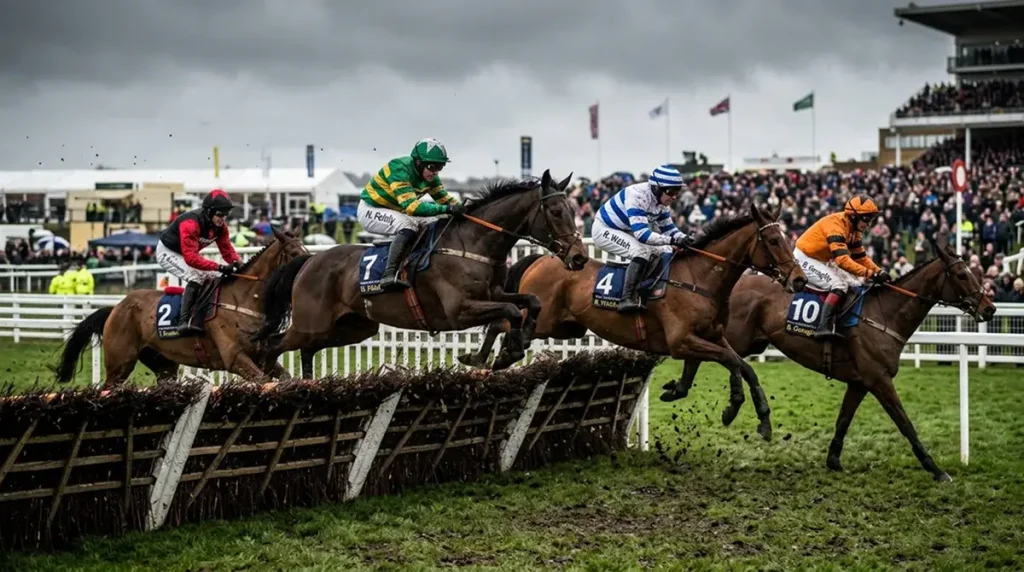
The Grand National at Aintree in April is the UK's single biggest betting event by participation. The 40-runner field — the largest in mainstream racing — generates unique market dynamics. Each-way terms typically pay four or five places at 1/4 odds, which makes it one of the few races where a 33/1 each-way shot carries genuine structural value. The race's crossover appeal means betting participation spikes among people who bet on nothing else all year. Total prize money across UK racing reached £153 million in the first nine months of 2025, a figure heavily weighted toward these headline fixtures.
Royal Ascot in June is the premier Flat meeting — five days featuring multiple Group 1 contests. The betting profile differs from jumps festivals: championship race fields can be smaller, tightening odds and reducing each-way value, but the handicaps — the Royal Hunt Cup, the Wokingham, the Buckingham Palace Stakes — produce big-field markets with competitive pricing. International runners complicate form analysis, creating both risk and opportunity.
The Epsom Derby in June is a Classic restricted to three-year-olds, where ante-post assessment relies heavily on trial races and the unique camber of the track. Glorious Goodwood in late July combines five days of high-class Flat racing on one of Britain's trickiest courses, where the draw and going conditions can override pure ability.
Participation in horse racing betting among UK adults fluctuates sharply with the calendar. Gambling Commission surveys recorded 7% participation during the April-to-July window in 2025 — the period covering the Grand National, Guineas, Derby, and Ascot — which dropped back to 4% from July to October as the Flat programme moves past its peak. Betting around these festivals is not just higher in volume; it is also where the broadest range of markets, the deepest liquidity, and the most generous promotional terms converge. For those watching at home, live streaming and in-play betting have made festival engagement from a phone screen nearly as immersive as being trackside. If you are going to concentrate your betting energy anywhere, these are the weeks that reward attention.
Building a Betting Approach That Lasts
In my second year of serious racing analysis, I kept a spreadsheet of every bet I placed. After 400 bets across seven months, my strike rate was 18% and my return on investment was minus 6%. That was the moment I realised two things: first, that 18% is actually a respectable hit rate for win-only betting at average prices of 5/1; second, that a minus 6% ROI meant I was losing slowly rather than quickly — and slow losses are fixable. Fast, undisciplined losses are not.
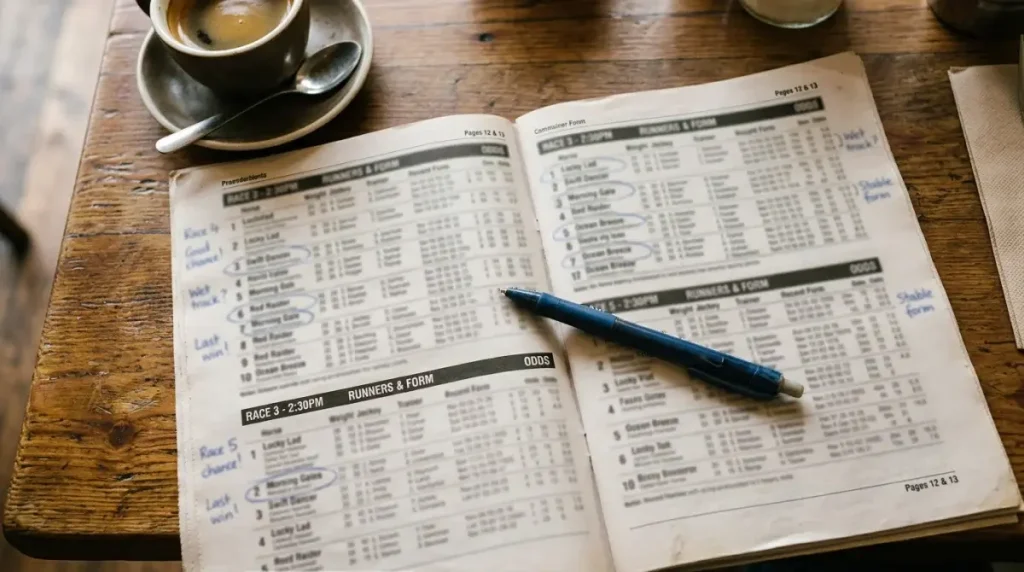
A lasting approach starts with form. Recent finishing positions, the quality of races previously contested, distance preferences, going preferences, and trainer-jockey combinations all feed into an assessment. The mistake most punters make is weighting one variable too heavily — typically the most recent result — while ignoring context like a step up in class, a change of distance, or the fact that a horse's best form came on soft ground and today's going is good to firm.
Before placing any bet, run through these checks:
- Have you read the form for at least the last five runs?
- Do you know the going and does it suit this horse?
- Has the horse run over today's distance before, and how did it perform?
- Is the trainer in form — what is the yard's strike rate over the past 14 days?
- Is the jockey booking significant? A leading rider on an outsider is worth noting.
- Does the price represent value against your own assessment of the horse's chance?
- Are you betting within your pre-set staking limits for the day?
Value is the concept that separates long-term winners from long-term losers. If you assess a horse's true probability of winning at 25% and the bookmaker's odds imply a 16% probability (around 5/1), you have a value bet. The margin between your estimate and the market's estimate is your edge. The problem is that your estimate needs to be accurate over a meaningful sample. A handful of bets proves nothing; a thousand bets reveal whether your method holds. The sport's culture emphasises study, patience, and the acceptance that losing streaks are inevitable — which is the right mindset regardless of whether you are betting £5 or £500.
Do
- Set a monthly betting budget and treat it as an entertainment expense, not an investment.
- Record every bet — stake, odds, result, and a one-line note on your reasoning.
- Review your record quarterly. Look for patterns in your losses, not just your wins.
- Accept that even the best professional punters operate at single-digit ROI percentages.
Don't
- Chase losses by increasing stake sizes after a bad day.
- Back a horse because of a "feeling" or a tip without doing your own form analysis.
- Confuse a winning streak with skill. Short-term variance in racing is enormous.
- Ignore bankroll management because you are "only betting small amounts."
Bankroll discipline is unglamorous and non-negotiable. Stake a fixed percentage of your total bankroll per bet — typically between 1% and 3% — and adjust the cash amount as your bankroll fluctuates. Level staking is the easiest system to implement. Variable staking can improve returns if your confidence calibration is accurate, but for most punters it introduces unnecessary risk.
The full mechanics of form reading, value identification, and staking plans are in my horse racing betting strategy guide. The mindset I want to leave you with is that betting on horse racing is a craft. The more you study, record, and honestly assess your results, the better your outcomes will be — not guaranteed profits, but informed, disciplined engagement with a sport that rewards attention.
Responsible Gambling: Tools, Data, and Self-Assessment
I have a deposit limit set on every account I hold. Not because I have a gambling problem, but because I know myself well enough to recognise that a bad Saturday at the races can push me into decisions I would not make on a Wednesday morning with a clear head. Self-awareness is not weakness — it is the most underrated tool in any punter's kit.
If you or someone you know is experiencing difficulties with gambling, the National Gambling Helpline can be reached at 0808 8020 133 (free, 24/7). GamCare provides confidential support, and GAMSTOP allows self-exclusion from all UKGC-licensed operators.
48% of UK adults participated in some form of gambling in the four weeks prior to the survey — falling to 27% when the National Lottery is excluded. Source: UKGC Gambling Survey for Great Britain, Wave 3.
The Gambling Commission's GSGB survey provides the most comprehensive picture of gambling participation in the UK. In late 2025, 48% of adults had gambled in the preceding four weeks; excluding the lottery, that figure drops to 27%. The 25-to-34 age bracket showed the highest non-lottery participation at 35%. Horse racing specifically sees seasonal fluctuation — 7% of adults bet on racing during the April-to-July peak, dropping to 4% outside festival season.
Horse racing bettors, as a demographic, have historically shown a relatively low rate of problem gambling. The Health Survey for England measured a 2.8% problem gambling rate among horse racing participants using the PGSI and DSM-IV screening tools. That is notably lower than some other forms of gambling, but it is not zero, and it is worth understanding what tools are available to manage your engagement.
Every UKGC-licensed operator is required to offer deposit limits, loss limits, session time limits, and cooling-off periods — accessible in the "safer gambling" section of your account settings. GAMSTOP is the national self-exclusion scheme: registering blocks you from all UKGC-licensed online gambling for a minimum of six months. It does not cover unlicensed operators, which is one reason the growth of the black market is a consumer welfare concern as much as an economic one.
The responsible path is not to avoid gambling tools because you think they do not apply to you. Use them proactively, set your limits before your first bet of the day, and treat the whole apparatus as part of the infrastructure of informed betting — no different from form analysis or bankroll management.
Frequently Asked Questions
Is online horse racing betting legal in the UK?
Yes. Online horse racing betting is fully legal in the UK for anyone aged 18 or over, provided you use a bookmaker licensed by the UK Gambling Commission. The UKGC maintains a public register of all licensed operators where you can verify any site's licence status directly. Unlicensed operators are illegal and offer no consumer protection. The legal framework is governed by the Gambling Act 2005, as amended by subsequent regulations.
How do horse racing odds work?
UK horse racing odds are most commonly displayed in fractional format — 5/1 means £5 profit for every £1 staked, plus your stake back. Decimal format expresses total return: 5/1 becomes 6.00. Every set of odds carries an implied probability — a horse at 4/1 has an implied 20% chance. The sum of all implied probabilities exceeds 100%; that excess is the bookmaker's margin. The dedicated odds guide elsewhere on this site covers formats, starting price mechanics, and margin calculations in depth.
What does Best Odds Guaranteed mean?
Best Odds Guaranteed, commonly abbreviated to BOG, means that if you take an early price on a horse and the starting price turns out to be higher, you receive the SP instead. Back a horse at 5/1 in the morning, the SP drifts to 7/1 — with BOG, you are paid at 7/1. If the SP is lower, you keep your original price. BOG effectively removes the downside of taking an early price. Not all operators offer it on all races, and some exclude ante-post markets, so check the specific terms.
What are the biggest horse racing events to bet on in the UK?
The four flagship meetings generating the highest betting volumes are the Cheltenham Festival (March, four days of National Hunt racing), the Grand National at Aintree (April, the UK's single biggest betting race), Royal Ascot (June, five days of elite Flat racing), and the Epsom Derby (June, the premier Classic). Glorious Goodwood and the autumn festivals at Ascot and York also drive significant turnover. Betting participation peaks at 7% of UK adults during April to July and drops to 4% outside festival season.
How do I choose a horse racing betting site?
Start with licensing — only use UKGC-licensed operators, verifiable on the Commission's public register. Then evaluate odds quality by comparing early prices across operators, BOG availability, live streaming coverage, racing-specific tools (racecards, form data, early prices), and mobile performance. The most effective approach is maintaining accounts with several operators so you always access the best price. Welcome bonuses should be a secondary consideration.
What are affordability checks and how do they affect punters?
Affordability checks are financial assessments that UKGC-licensed operators conduct when a customer's net deposits exceed certain thresholds. Since February 2025, the trigger is £150 in net monthly deposits, down from £500. Crossing this threshold may prompt requests for proof of income or bank statements. The Racing Post's 2025 survey found 23.7% of respondents had faced these checks. Industry bodies warn the process is pushing some bettors toward unlicensed operators — a trade-off with significant consumer protection implications.
What is the best type of bet for beginners in horse racing?
A straightforward Win bet — backing a horse to finish first — is the simplest place to start. The maths is transparent, the outcome is binary, and you learn to read odds without worrying about place terms or combination structures. Once you are comfortable with Win bets, an each-way bet on a bigger-field race (10+ runners) is a natural next step — it gives you two chances of a return (win or place) for double the stake. Avoid accumulators and exotic bets like forecasts and tricasts until you have a solid understanding of form and value. The bet types guide on this site covers every option in detail.
Articles
Created by the "Betting Online Horse Racing" editorial team.
