
Horse Racing Form Symbols and Racecard Codes
 Available in US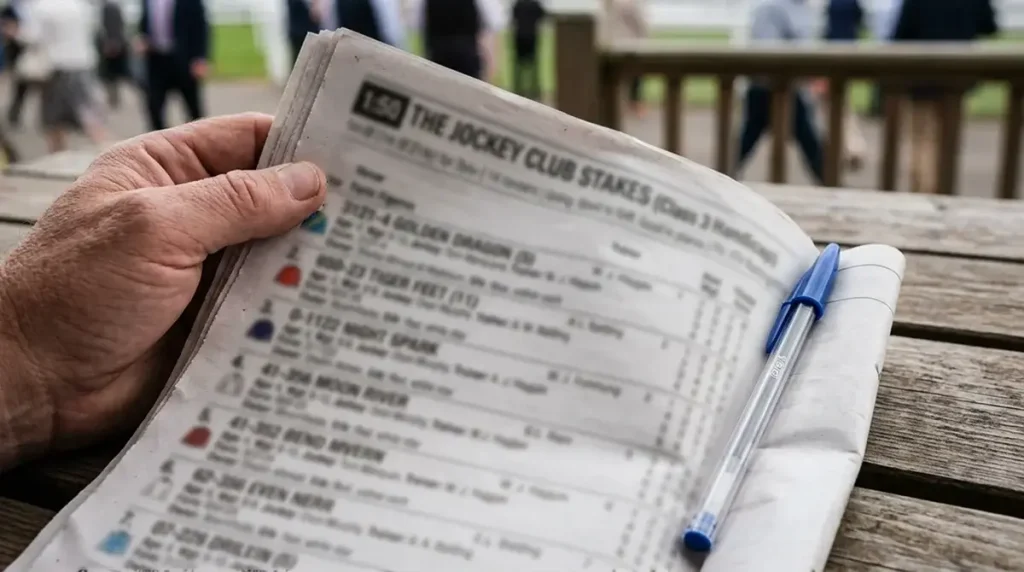
I spent my first year of serious racing betting ignoring the form column on racecards. I looked at the odds, picked names I recognised, and wondered why I kept losing. The day I sat down and actually decoded a form string — 1230-4F — was the day my approach changed permanently. Those letters and numbers are not decoration. They are a compressed history of every horse’s career, and once you can read them fluently, the racecard stops being a list of names and becomes a dataset.
This is a reference guide to every significant symbol and abbreviation on a UK racecard. I have structured it by category rather than alphabetically, because understanding the context behind each code matters more than memorising definitions.
Finishing Positions and Form Figures Analyzed
The form string reads right to left in chronological order — the most recent run is on the right. A string like “21312” means this horse finished second, first, third, first, second across its last five starts, with the “2” on the far right being its latest run.
The numbers 1 through 9 represent finishing positions. A “0” means the horse finished outside the first nine — tenth or worse. An “F” means it fell, “U” means it unseated its rider, “P” means it was pulled up by the jockey, “R” means it refused a fence, and “B” means it was brought down by another horse’s mistake. Each of these codes tells a different story. A fall at the last when upsides the leader is a very different signal from pulling up tailed off after half a mile.
The dash or hyphen separates racing seasons. A form string of “1231-4” tells you the horse won, placed second, placed third, and won in the previous season, then finished fourth on its first start this season. That seasonal break matters: a horse returning from a layoff might need a run to reach peak fitness, and a “4” first time out after a break is often more encouraging than a “4” in mid-season when the horse should be fully fit.
The number of high-quality horses in flat racing — those with a performance figure of 90 or above — reached 1,423 in 2025. That quality concentration means form figures carry more weight in graded and listed company than in low-grade handicaps, where the difference between first and eighth might be half a length and a lucky run through on the rail.
Letters attached to numbers add further detail. A lowercase “t” after a position (like “3t”) indicates the horse was wearing a tongue tie for the first time. A lowercase “h” signals a first-time hood. These equipment changes are flagged because they can indicate the trainer is trying something new to improve the horse’s performance, which is a useful betting signal.
Headgear and Equipment Codes
If you have ever wondered why some horses wear hoods to the start, blinkers during the race, or cheekpieces that look like oversized earmuffs, the answer is usually focus. Different headgear addresses different behavioural issues, and the racecard tells you exactly what each horse is wearing.
“b” stands for blinkers — cups that restrict a horse’s peripheral vision to keep it focused on what is ahead. First-time blinkers are one of the strongest positive signals in racing form. A horse that has been running lazily or hanging to one side often shows dramatic improvement when blinkers are applied for the first time. I track first-time blinker runners as a standalone angle, and the win rate on that subset consistently outperforms the overall market strike rate.
“v” indicates a visor, which is similar to blinkers but with a small slit allowing some peripheral vision. Visors are a less aggressive intervention and typically suit horses that need encouragement rather than restriction. “p” is for cheekpieces — sheepskin rolls attached to the cheek straps that narrow the horse’s field of vision without blocking it entirely. “h” marks a hood, worn to the start to keep the horse calm before the race begins and then removed before the off.
“e/s” denotes ear plugs, which muffle crowd noise and are removed by pulling a cord as the race begins. “t” marks a tongue tie, a fabric strap that keeps the horse’s tongue in position to prevent it from obstructing the airway during intense exertion. Tongue ties are an increasingly common intervention, and first-time application is another data point worth tracking.
The key is not just knowing what the codes mean but noticing when they change. A horse adding blinkers for the first time after three moderate runs is a different proposition from one that has worn blinkers in every start. The addition signals intent from the trainer; the continuation signals dependence.
Going Preferences, Course, and Distance Indicators
The UK horse population in training is declining at roughly 1.5% annually. With fewer horses contesting each race, the runners who do participate tend to be more carefully placed by trainers on ground and at distances that suit them. This makes the racecard’s course-and-distance codes more predictive than ever.
“C” means the horse has won at this specific course before. “D” means it has won over this exact distance. “CD” means both — a previous winner at this course over this distance. “BF” indicates the horse was a beaten favourite last time out, which can be a positive signal if the defeat was narrow or explained by circumstances like a troubled passage or unsuitable ground.
Going preferences are listed separately on most racecards. A horse described as preferring “good to soft” or “soft” ground has a documented record of performing best under those conditions. This information is critical because ground conditions can change between the morning of a race and the off. A horse with a strong preference for soft ground running on ground that has dried out to good is at a measurable disadvantage, regardless of what its recent form figures suggest.
“J” appears on some racecards to flag that the jockey’s claim has changed — typically a conditional or apprentice jockey claiming a weight allowance. The weight allowance can be 3, 5, or 7 pounds depending on the rider’s experience level, and it effectively alters the handicap equation. A horse carrying 9 stone 7 with a 5-pound claimer rides at 9 stone 2 in practice, which can be the difference in a tight handicap.
One code that catches newcomers off guard: “OR” followed by a number represents the horse’s official rating as assigned by the handicapper. A horse rated OR 95 in a Class 3 handicap (typical rating band 81-95) is running at the top of its class and theoretically faces stiffer competition from every runner in the race. Conversely, a horse rated OR 82 in the same race has more weight in hand and might outperform its odds. Understanding where a horse sits within the race’s rating band is one of the fastest ways to filter a field. For more on how these form elements feed into a broader selection method, the form-first framework for strategy puts the pieces together.
What does C&D mean on a horse racing form guide?
C&D stands for Course and Distance. It indicates the horse has previously won at this specific racecourse over this exact distance. A C&D winner has proven it handles the track"s characteristics and the trip, which can be a meaningful positive indicator — particularly at courses with unusual features like sharp bends, undulations, or testing gradients.
How do you interpret a horse"s form figures like 1230-4?
Read the numbers right to left, with the rightmost figure being the most recent run. 1230-4 means: the horse won (1), then finished second (2), third (3), outside the first nine (0) in the previous season — the dash marks the season break — and finished fourth (4) on its first run of the current campaign. The seasonal break is important context: a fourth-place finish first time out after a layoff may signal a horse that needs a run to reach peak fitness.
Articles
Published by the Betting Online Horse Racing team.
