
Tote Pool Betting for Horse Racing: How Pari-Mutuel Markets Work in the UK
 Available in US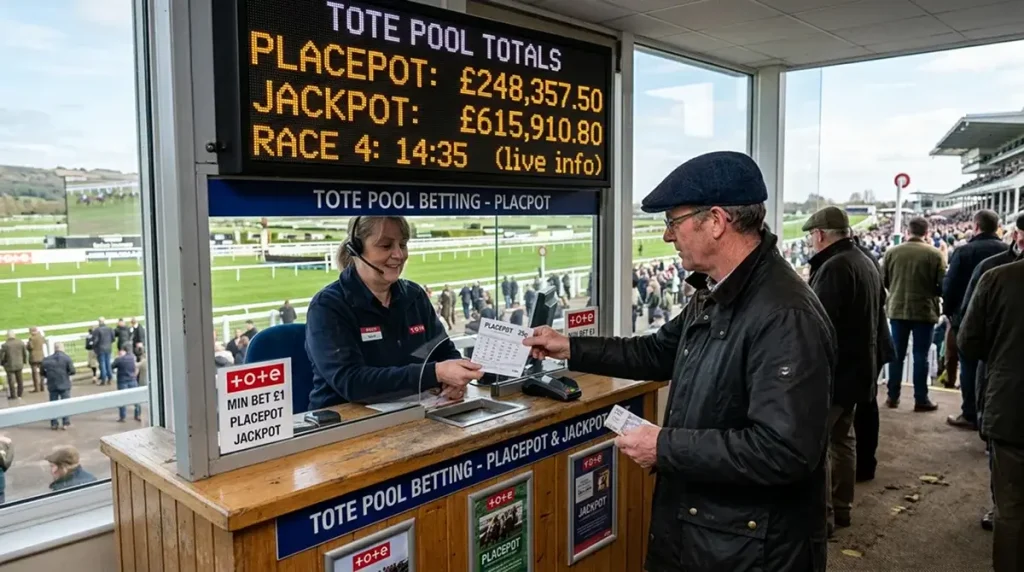
My introduction to pool betting was a two-pound Placepot at Aintree that returned 847 pounds. Six races, six selections that just needed to place, and a dividend that made the entire weekend. I have been chasing that feeling at pool windows and online Tote screens ever since. Pool betting is the oldest form of organised horse racing wagering in the world, and in the UK it offers something that bookmakers and exchanges cannot: a payout determined by the collective weight of every other punter’s money, not by a bookmaker’s margin calculation.
Remote horse racing GGY reached 766.7 million pounds in 2024-25 across all betting channels. Pool betting accounts for a small fraction of that total, but its unique structure and the potential for outsized returns make it a distinct discipline worth understanding.
How Pool Betting Differs from Fixed-Odds Wagering
With a bookmaker, the price you take is the price you get. If you back a horse at 6/1, your return is fixed at six times your stake plus your stake back. The bookmaker has set that price based on their assessment of the market, and their margin is embedded in the overround.
Pool betting works differently. All stakes on a particular bet type — say, the Win pool — go into a single pot. After the operator’s deduction (typically 10-20% depending on the pool type), the remaining pot is divided among the winning tickets. The payout is not known until after the race, because it depends on how much money is in the pool and how many people picked the winner.
This creates two dynamics that do not exist in fixed-odds betting. First, a horse that is popular with the crowd — backed by many people — pays less than a horse that is overlooked. The pool is shared among all winning tickets, so more winners mean a smaller share each. Second, a horse that is unpopular but wins can return significantly more than its fixed-odds equivalent, because fewer tickets share the pool. I have seen Tote Win dividends return double the SP on lightly backed winners in big-field handicaps, simply because the public concentrated their money elsewhere.
The operator’s deduction is the pool equivalent of the bookmaker’s overround. On Win and Place pools, the deduction is typically around 12-14%. On more complex pools like the Placepot and Jackpot, it can be higher because the operator assumes more administrative and prize-guarantee risk. The effective cost to the punter depends on how efficiently the pool is distributed — a pool with a single winning ticket returns more per pound than a pool split among thousands.
Placepot and Jackpot: Entry, Selections, and Dividends
The Placepot is the most popular Tote pool in British racing, and it is the one I play most frequently. The concept: select a horse to place in each of the first six races at a meeting. If all six place, you share the Placepot pool. The minimum stake is one pound, and permutations allow you to select multiple horses in each race (at increased cost) to cover more outcomes.
A single-line Placepot — one horse in each of the six races — costs one pound. Selecting two horses in one race doubles the cost to two pounds. Selecting two horses in two races quadruples it to four pounds. A “banker” is a race where you select only one horse; a “perm” is where you select two or more. My typical Placepot strategy uses one or two bankers and two horses in the remaining races, keeping total outlay between eight and 16 pounds.
Placepot dividends vary wildly. On a day when the favourites place in all six races, the pool is shared among thousands of winning tickets and the dividend might be five or ten pounds. On a day when a shock result in one race eliminates most of the pool, surviving tickets share a much larger pot. UK racecourse attendance hit 5.031 million in 2025, and festival days with strong crowds generate the largest Placepot pools — sometimes exceeding 500,000 pounds — which means the dividends on those days can be substantial if the results go against the public money.
The Jackpot is the Placepot’s bigger, harder sibling: pick the winner of each of the first six races. Win, not place. The minimum stake and permutation logic are the same, but the difficulty is exponentially higher. Jackpot dividends can reach five or six figures when the pool rolls over after a day with no winner, creating accumulated pools that attract heavy interest. The risk-reward profile is closer to a lottery than a standard bet, and I treat Jackpot entries as entertainment spending rather than serious punting.
When Tote Odds Beat Bookmaker Prices
Tote Win odds are not always better than bookmaker prices — but they are often better in specific, predictable conditions.
Favourites typically pay less on the Tote than at the SP, because the public concentrates money on the most obvious contenders. A horse that is 2/1 SP might return only 2.50 to a pound on the Tote (equivalent to 3/2) because the pool is overloaded with favourite backers. This is the Tote’s structural disadvantage for frontrunner punters.
Longer-priced winners tell the opposite story. A 14/1 shot that wins with minimal Tote support might return 18/1 or even 22/1 on the Tote, because the pool is lightly distributed across that horse’s ticket holders. In big-field handicaps — the Royal Hunt Cup, the Cambridgeshire, the Lincoln — where the public money fragments across 20-plus runners, Tote dividends on unfancied winners consistently outperform the SP. Average per-race turnover on Premier Fixtures climbed 2.7% in 2025, and it is precisely these premium big-field races where the Tote pool is largest and the potential for outlier dividends is greatest.
My rule of thumb: if I am backing a horse at 10/1 or longer in a field of 14 or more runners, I check the Tote alongside the fixed-odds market. If the projected Tote return is comparable or better, I place through the Tote instead. On shorter-priced selections or smaller fields, the bookmaker price is usually the better option. For a comparison of how different wagering structures — including pools, exchanges, and fixed odds — each create distinct cost profiles for the punter, the full bet types breakdown covers all the mechanics in one place.
What is a Tote Placepot and how do I play it?
The Placepot requires you to select a horse to place in each of the first six races at a meeting. If all six selections finish in a place position, you share the Placepot pool dividend. The minimum stake is one pound per line, and you can select multiple horses in each race (permutations) to increase your chances at a proportionally higher cost. Placepot dividends vary dramatically depending on how many winning tickets survive all six races.
Are Tote dividends taxed in the UK?
No. Betting winnings, including Tote pool dividends, are not subject to income tax or capital gains tax for individual punters in the UK. The tax on gambling is paid by the operator, not the customer. This applies to all forms of legal horse racing betting — fixed odds, exchange, and pool — and has been the case since the abolition of on-course betting duty in 2001.
Articles
Prepared by the Betting Online Horse Racing editorial staff.
