
Horse Racing Betting Sites in the UK
 Available in US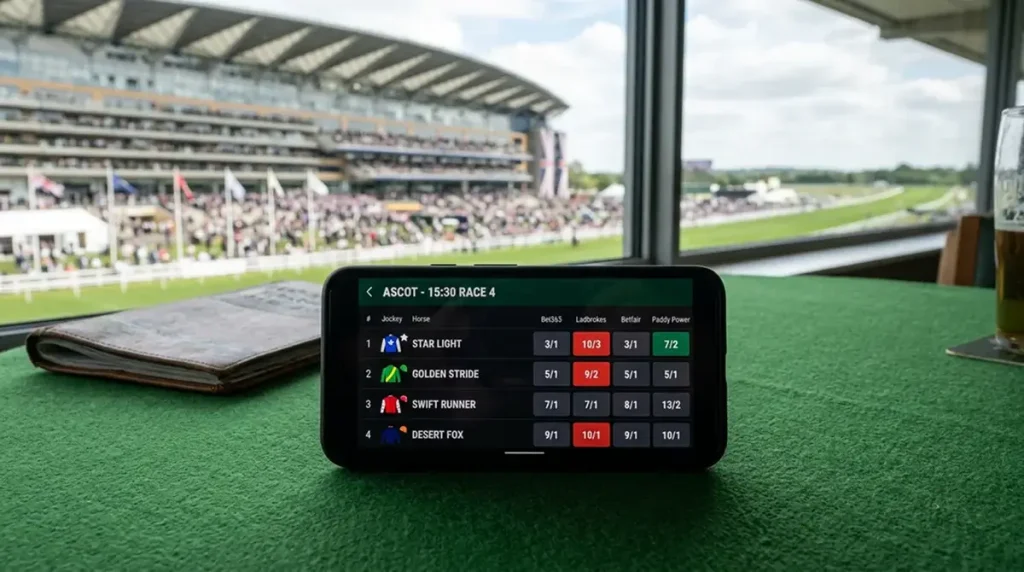
Every affiliate website in the UK horse racing space does the same thing: lists ten bookmakers, ranks them from “best” to “tenth best” based on criteria you can’t verify, and peppers the page with sign-up links. I’ve read dozens of these pages over the years. Not one of them gives you a framework for making your own assessment. They tell you what to choose. I’d rather tell you how to choose.
The UK horse and sports betting market is valued at £3.7 billion in 2026, with 499 companies operating in the sector. More than 120 of those operators are licensed specifically for horse racing. That’s a crowded field, and navigating it by relying on someone else’s ranking — someone who earns a commission when you sign up — is a poor start to a supposedly analytical hobby. The differences between operators are real and measurable: licensing status, odds quality, streaming access, mobile functionality, and the racing-specific tools that separate a site built for punters from one that treats racing as an afterthought next to football and accumulators.
This article gives you the evaluation criteria I apply when I’m deciding where to place my own money. No rankings, no scores out of ten, no affiliate links. Just the questions you should be asking and how to find the answers.
When choosing a new bookmaker, you should carefully evaluate horse racing free bets to ensure the wagering requirements are fair and achievable.
UKGC Licensing and Platform Security
Before I look at odds, features, or bonuses, I check one thing: does the operator hold an active UKGC licence? This isn’t a formality. A Gambling Commission licence means the operator is legally required to segregate customer funds, comply with responsible gambling protocols, contribute to the betting levy that funds British racing, and submit to regulatory audits. An unlicensed operator has none of these obligations. None.
Verifying a licence takes thirty seconds. Go to the Gambling Commission’s public register on their website, type in the operator’s name, and check that the licence is marked as active. The register shows the licence number, the licensee’s legal name, and the activities they’re authorised to conduct. If the operator isn’t on the register, they are not legal to offer gambling services to UK customers, regardless of what their website claims.
The number of licensed betting shops in the UK has dropped to 5,825 as of March 2025 — a 36% decline over the past decade. That contraction reflects the migration from physical retail to online platforms, and it makes the licensing question more important, not less. As the market moves online, the barriers to launching an unlicensed site drop. A website can look professional, offer competitive odds, and process deposits smoothly while operating entirely outside the regulatory framework. The visual appearance of a betting site tells you nothing about its legal status. The UKGC register does.
I keep accounts with multiple licensed operators, and the licensing check is the gateway. If an operator fails this step, nothing else about them matters. The odds could be the best in the market, the interface could be flawless, and the welcome offer could be extraordinary — none of it compensates for the absence of legal protection, fund segregation, and recourse through the Gambling Commission’s complaints process. This is the one criterion where there’s no trade-off to weigh. It’s binary.
The UK leads the global market for horse racing betting platforms, with annual investment of approximately $150 million in platform development across licensed operators. That investment in technology, compliance infrastructure, and product quality is funded in part by the regulatory fees operators pay to maintain their licences. When you bet with a licensed operator, you’re betting within a system that has financial accountability built into its structure. When you bet outside it, you’re trusting a website with your money and your personal data, with no regulator to intervene if something goes wrong.
Odds Quality and Best Odds Guaranteed Policies
I once tracked the same horse across six different operators on a midweek card at Kempton. The win price ranged from 7/2 to 9/2. On a £50 stake, that’s the difference between a £175 return and a £225 return. Over a year of regular betting, those gaps compound into hundreds of pounds — not because of better selections, but because of better prices on the same selections.
Odds quality is the single most impactful variable after selection accuracy, and it’s the easiest one to measure. Odds comparison tools aggregate prices across the licensed market, and checking them before you place takes seconds. The point isn’t to find one operator who’s consistently cheapest — markets shift, and different operators lead on different races. The point is to maintain accounts with enough operators that you can almost always get near the best available price.
Best Odds Guaranteed is the policy that eliminates one specific risk: the risk that the price you take in the morning is lower than the starting price at the off. Under BOG, if you back a horse at 5/1 and the SP drifts to 7/1, you’re paid at 7/1. If the SP contracts to 3/1, you still get your 5/1. It’s a one-way ratchet in the punter’s favour, and it’s the single most valuable promotion in UK racing. William Hill captured 37.83% of PPC clicks in the sports betting space as of February 2026, and the major operators use BOG as a competitive tool precisely because punters recognise its value. For a deeper look at the mechanics and limitations, I’ve covered Best Odds Guaranteed in horse racing separately.
Not all BOG policies are equal. Some operators restrict it to UK and Irish racing only. Some exclude ante-post markets. Some cap the maximum payout enhancement. Read the terms before assuming the policy works universally. The quality of an operator’s BOG offering — how broad the coverage, how few the exclusions — is one of the clearest indicators of how seriously they take the racing market.
Live Streaming and Race Coverage Depth
Watching a race live while you have money on it changes how you experience betting. It also changes how you learn. Watching replays after the fact tells you what happened; watching live teaches you how races unfold in real time — where the pace is set, how the field responds, when the jockeys commit. That feedback loop sharpens your reading of form over time in a way that results alone can’t.
Most major licensed operators offer live streaming of UK and Irish racing to customers with a funded account or a recently placed bet. The technical requirements are minimal — a stable internet connection and an up-to-date browser or app. The quality of the stream and the breadth of race coverage vary between operators. Some cover every UK meeting daily. Others stream selectively, focusing on bigger fixtures and omitting smaller cards.
UK racecourse attendance hit 5.031 million in 2025 — the first time the figure crossed five million since 2019. That physical attendance figure is impressive, but the overwhelming majority of betting activity happens off-course, delivered through screens. The streaming experience is how most punters interact with the sport. An operator that covers more meetings gives you more opportunities to bet on races you’ve actually watched, and watching is part of the process if you’re serious about improving.
Check the streaming section of any operator you’re considering by looking at coverage on a regular Tuesday or Wednesday, not on a Saturday during a festival. Saturday coverage is near-universal. It’s the mid-week cards — the bread and butter of daily racing — where coverage gaps appear. If you bet primarily on weekday racing, an operator with patchy mid-week streaming coverage is functionally less useful to you than one that covers the full calendar.
Mobile Apps and Betting on the Move
The numbers make the trend unambiguous. Licensed betting shops have fallen 36% in a decade to 5,825 outlets. Online GGY for the remote sector grew 8% year on year to £1.42 billion in Q2 2025. The migration from counter to screen is effectively complete, and within that screen-based world, mobile is dominant. If a betting site’s mobile experience is poor, nothing else about it matters for the majority of punters.
What defines a good mobile experience for horse racing? Speed matters more than aesthetics. The racecard needs to load quickly, the odds need to update without manual refreshing, and placing a bet should require no more than three taps from the racecard to the bet slip to confirmation. Anything more than that and the interface is getting in the way of the activity it’s supposed to support.
Navigation is the second priority. A horse racing bettor uses the app differently from a football accumulator builder. You need to find a specific meeting, a specific race, and a specific runner. The hierarchy should be: sport, meeting, race, runner. If the app buries racing behind promotional banners or forces you to scroll past football fixtures to reach the racing section, it wasn’t built with racing punters in mind.
Live streaming integration within the app is the third criterion. Watching a race in the app while your bet slip is visible — without switching between separate screens or applications — is the standard that serious operators meet. If the app requires you to leave the streaming player to check your bet or navigate to another race, the experience fractures at precisely the moment when engagement should be highest. Test the app on a live racing afternoon before committing to the platform as your primary account.
Notifications and alerts are an underrated feature. Some apps allow you to set reminders for specific races, receive push notifications when a horse you’ve backed is about to run, or get alerted when early prices are released for the next day’s racing. These aren’t gimmicks — they’re practical tools for a punter who juggles racing with a day job and doesn’t have time to monitor the market constantly. An app that keeps you informed without requiring your constant attention is more useful than one with a prettier interface that you have to check manually.
Racing-Specific Tools: Racecards, Form, and Early Prices
This is where the separation happens. A generic sportsbook offers horse racing as one tab among thirty sports. A racing-focused platform treats every meeting as a product, with integrated racecards, form data, trainer and jockey statistics, and early price markets that open the day before. The tools available on the platform determine how efficiently you can assess a race without leaving the site to consult external form databases.
The racecard is the central tool. At minimum, it should display the runner’s name, number, draw (for flat races), jockey, trainer, weight, official rating, and recent form figures. Better implementations add colours, headgear indicators, going preferences, and links to detailed form profiles. Some operators integrate speed figures or sectional time data — rare, but increasingly available as the industry invests in technology. Betfair UK introduced predictive AI for odds in 2025, reducing settlement delays by 28%, which signals the direction the market is heading. Operators that invest in data tools are signalling their commitment to the racing product.
Early prices — odds available the evening before or morning of a race — are important for racing punters because they allow you to take a price before the market reacts to on-course money, non-runner announcements, and going changes. If an operator only opens their racing markets thirty minutes before the off, you’re arriving after the early value has been taken. Look for operators who price up the following day’s racing by early evening and offer BOG from the moment those prices go live.
Results and form archives matter too, though they’re often overlooked. Being able to look up a horse’s complete racing history, view race replays, and check past course form within the operator’s platform saves time and keeps your analysis workflow in one place. The operators who invest in these tools are building for the punter who treats racing as a skill-based activity. The ones who don’t are building for the punter who treats it as a slot machine with animals. Know which one you are, and choose accordingly.
Major Operator Groups Behind UK Betting Brands
The UK betting market is more consolidated than most punters realise. The brands you see on the high street and online are largely owned by a handful of parent companies, and understanding that ownership structure tells you something about the resources, technology, and regulatory standing behind the brand you’re betting with.
Flutter Entertainment, which owns a portfolio including major UK-facing brands, reported group revenue of $15.91 billion for 2025 — a 17% increase on 2024 — with adjusted EBITDA rising 21% to $2.85 billion. That scale funds technology investment, market depth, and the financial resilience to honour large payouts. Entain PLC, the parent of several prominent high-street and online brands, reported net gaming revenue of £5.3 billion in 2025, with its UK online division posting 15% volume growth.
Why does this matter to you as a punter? Because the parent company’s financial health affects the product you receive. A well-capitalised operator can afford to offer competitive odds, broad streaming coverage, and generous BOG policies without cutting corners on compliance. A smaller, thinly capitalised operator may offer flashy promotions to attract deposits but lack the infrastructure to maintain product quality or the reserves to pay out large wins promptly.
HBLB chief executive Alan Delmonte captured the tension when he acknowledged that while levy income had risen for a fourth consecutive period, the Board continues to express caution about sustainability given the ongoing fall in betting turnover. That caution applies at the operator level too. In a market where turnover is shrinking, the operators best positioned to maintain product quality are those with diversified revenue streams and strong balance sheets. When you evaluate a betting site, look past the brand name to the business behind it. Annual reports are public. Licence records are searchable. The information is there if you’re willing to spend ten minutes finding it.
How to Assess Welcome Offers for Horse Racing
Welcome offers are the flashiest part of the sign-up process and the part where the gap between headline and reality is widest. “Bet £10 Get £30 in Free Bets” sounds like free money. It isn’t. Every offer comes with terms that determine whether the promotional value is genuine or illusory, and those terms are designed to be skimmed rather than read.
The first question is eligibility: does the offer work on horse racing? Many welcome bonuses are restricted to specific sports or market types. An offer that requires your qualifying bet to be placed on football at minimum odds of 2.0 is worthless to someone who wants to bet on a 4/6 favourite in the 3:15 at Newbury. Check the qualifying conditions before you deposit.
Find the most reliable platforms and daily market insights on our trusted UK horse racing betting portal.
The second question is the mechanism. “Free bet” and “bonus funds” are different products. A free bet typically means you receive a bet token of a certain value; if the bet wins, you receive the profit but not the free bet stake. This is called “stake not returned” and it reduces the effective value of the free bet significantly. A £30 free bet at 3/1 returns £90 profit but not the £30 stake, so it’s worth £90 rather than the £120 a normal winning £30 bet would return. Bonus funds usually come with wagering requirements — you might need to turn the bonus over five or ten times before you can withdraw. On a £30 bonus with a 5x wagering requirement, you’d need to place £150 in bets before the bonus converts to withdrawable cash.
The third question is time. Most offers expire within 7 to 30 days. If you don’t use the free bets or clear the wagering requirement within that window, the promotional value vanishes. For horse racing, this is less of an issue because there’s racing nearly every day, but it still catches people who sign up casually and forget to follow through.
My approach to welcome offers is straightforward: I claim them when the terms are reasonable and the operator is one I’d use anyway. I never choose an operator primarily because of its welcome offer. The offer is a one-time event. The odds quality, streaming coverage, and racing tools are what you’ll live with every day after the welcome bonus is gone.
How many licensed horse racing betting sites operate in the UK?
The UK has more than 120 operators licensed specifically for horse racing, within a broader market of 499 betting companies. You can verify any operator"s licence status through the Gambling Commission"s public register, which displays the licence number, licensee name, and current status. Only operators with an active UKGC licence are legal to offer gambling services to UK customers.
What racing-specific features should a bookmaker offer?
Look for integrated racecards with form data, official ratings, and trainer-jockey statistics. Early prices that open the evening before race day, combined with Best Odds Guaranteed from the moment those prices go live, are important for value-conscious punters. Live streaming of UK and Irish meetings, results archives with replays, and a mobile app that allows you to watch and bet simultaneously without switching screens are the markers of a platform built for racing.
Is it worth having accounts with multiple bookmakers?
Yes. No single operator consistently offers the best odds across every race. Maintaining accounts with several licensed operators allows you to compare prices and take the best available odds on each selection. Over a season, the cumulative effect of consistently getting even slightly better prices adds up to a meaningful difference in your overall return. The cost is a few minutes of comparison before each bet.
Articles
Written by the editors at Betting Online Horse Racing.
