
Betting Shop Decline in UK Horse Racing: 36% Fewer Outlets in Ten Years
 Available in US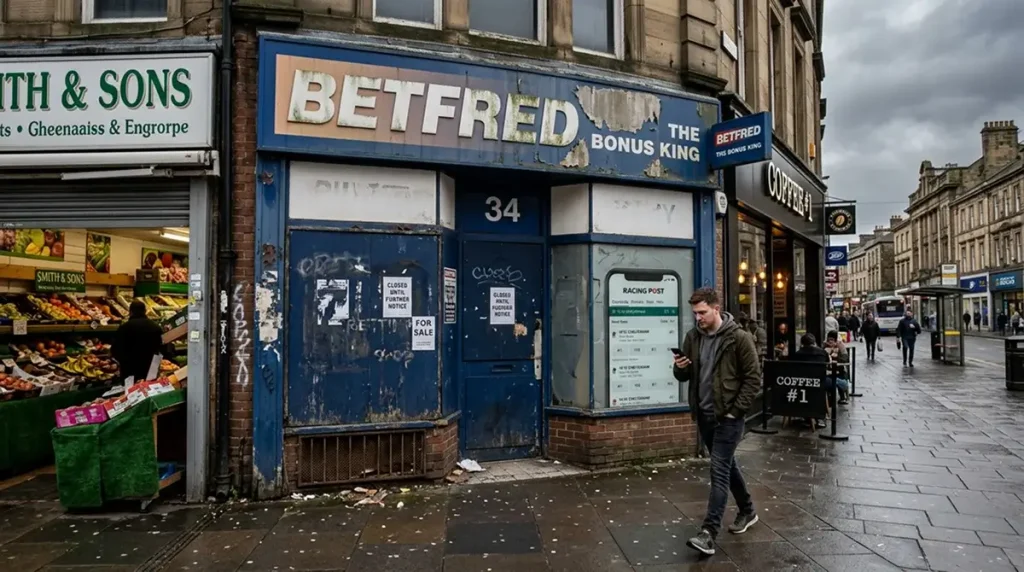
The betting shop where I placed my first horse racing bet closed in 2021. It was a Coral on a suburban high street in the Midlands — fluorescent lighting, carpet tiles, a wall of screens showing afternoon cards from Kempton and Wolverhampton. The staff knew the regulars by name. The atmosphere on a Saturday was electric, a room full of people watching the same race and reacting in real time. That shop is now a vape store. Its closure was not an isolated event. It was part of a structural contraction that has reshaped how British punters interact with horse racing.
The number of licensed betting shops in the UK has fallen to 5,825 as of March 2025 — a decline of 36% over the past decade. That is more than 3,000 shops gone from high streets and town centres across Britain. The shift from physical to digital is not a prediction or a trend. It is a completed migration for the majority of racing bettors, and the consequences extend beyond convenience into the economics and culture of the sport itself.
How Many Shops Have Closed and Where
Walk through any medium-sized British town and count the betting shops. Five years ago you might have found four or five within walking distance of the centre. Today you are likely to find two, and one of those may look like it is operating on borrowed time.
The 5,825 figure represents the licensed estate as of March 2025. A decade earlier, the total stood above 9,000. The steepest period of closures came between 2019 and 2022, driven by the FOBT stake cut to two pounds, the pandemic lockdowns, and the accelerating shift to mobile betting. The pace of closure has slowed since 2023, but it has not stopped — the remaining estate is still contracting, just more slowly as the weakest locations have already gone.
The closures have not been evenly distributed. Deprived urban areas lost shops fastest because those locations depended most heavily on FOBT revenue to sustain rent and staffing costs. When the maximum stake dropped from 100 pounds to 2 pounds in April 2019, the business model for many shops became unviable overnight. Rural and suburban shops followed as the customer base migrated online. The survivors tend to be larger premises in higher-footfall locations — the flagship shops of major operators like Ladbrokes, William Hill, and Coral, which double as brand presence and customer acquisition points.
Gambling transactions across the UK rose 7% in January 2026 compared to the same month a year earlier. But that growth is happening almost entirely online. The physical betting shop is becoming a heritage feature of British gambling rather than its commercial engine.
The Migration to Online and Mobile Platforms
I remember the first time I watched a race on my phone while placing an in-play bet simultaneously. It was around 2016, the technology was clunky, and the stream kept buffering. Today the experience is seamless — live HD streaming, one-tap bet placement, instant settlement. The migration happened because the product improved dramatically, not simply because shops closed.
The UK horse and sports betting industry is valued at 3.7 billion pounds in 2026, with 499 companies operating in the sector. The vast majority of that revenue now flows through digital channels. Online GGY for the remote sector grew 8% year on year to 1.42 billion pounds in mid-2025, while the physical estate shrank. The two trends are connected but not symmetrical — online is growing faster than retail is declining, which means the total market is expanding even as shops disappear.
Mobile has been the decisive technology. The ability to bet from anywhere, at any time, with live streaming built into the app, removed the primary reason most casual punters visited a betting shop. The shop offered convenience, atmosphere, and access to live pictures. The phone offers all three without requiring you to leave the house. For the UK’s roughly 120 licensed operators investing approximately 150 million dollars annually in platform development, mobile is where the money and the innovation go.
What Fewer Shops Mean for Horse Racing Engagement
Here is what concerns me most about the shop decline: betting shops were the gateway drug for horse racing interest. A person might walk in to bet on football, glance up at the screen, notice a 3:15 at Newbury, and place a flutter on a horse with a name they liked. That accidental discovery — the serendipity of physical proximity — does not happen on an app. On an app, you navigate to horse racing deliberately, which means you already have to be interested.
Racing participation rates reflect this dynamic. Participation in horse racing betting reached 7% of UK adults during the spring racing season in 2025 but dropped to 4% by autumn. That seasonal swing is normal, but the baseline is lower than it was five years ago. The sport’s audience is contracting even as racecourse attendance has recovered to 5.031 million — the highest since 2019. The people who go racing are engaged. The casual bettor who might have encountered racing in a shop is disappearing from the market.
Alan Delmonte, the HBLB’s Chief Executive, has framed the challenge directly: if racing is to continue as a leading sport and leisure activity, it needs to be presented and structured in a way that is attractive to the modern consumer. That is a polite way of saying the sport cannot rely on betting shops as its customer funnel any more. It needs to compete for attention on digital platforms against football, tennis, virtual sports, and casino products — all of which are optimised for mobile engagement in ways that racing’s traditional card-by-card format is not.
The shop decline also affects the levy indirectly. Retail betting generates lower margins than online for operators, but it contributes to the overall turnover base from which the Horserace Betting Levy Board collects its funding. As the retail channel shrinks, the levy becomes increasingly dependent on online performance — and online horse racing now competes with streaming-enabled in-play markets across every sport for the same customer’s attention and bankroll.
How many betting shops are left in the UK?
As of March 2025, there were 5,825 licensed betting shops in the UK. This represents a decline of approximately 36% over the previous decade, from a peak above 9,000. The rate of closure has slowed since 2023, but the estate continues to contract as customers migrate to online and mobile platforms.
Has the decline in betting shops affected horse racing betting volumes?
The relationship is indirect but real. Betting shops served as a casual entry point for horse racing — punters encountered racing on screens while visiting for other reasons. That accidental discovery does not replicate on mobile apps, where users must actively navigate to racing. Overall horse racing betting participation has declined alongside the shop closures, though separating cause from correlation is difficult because multiple factors are at work simultaneously.
Articles
Published by the Betting Online Horse Racing team.
