
AI in Horse Racing Betting: What Predictive Models Mean for UK Punters
 Available in US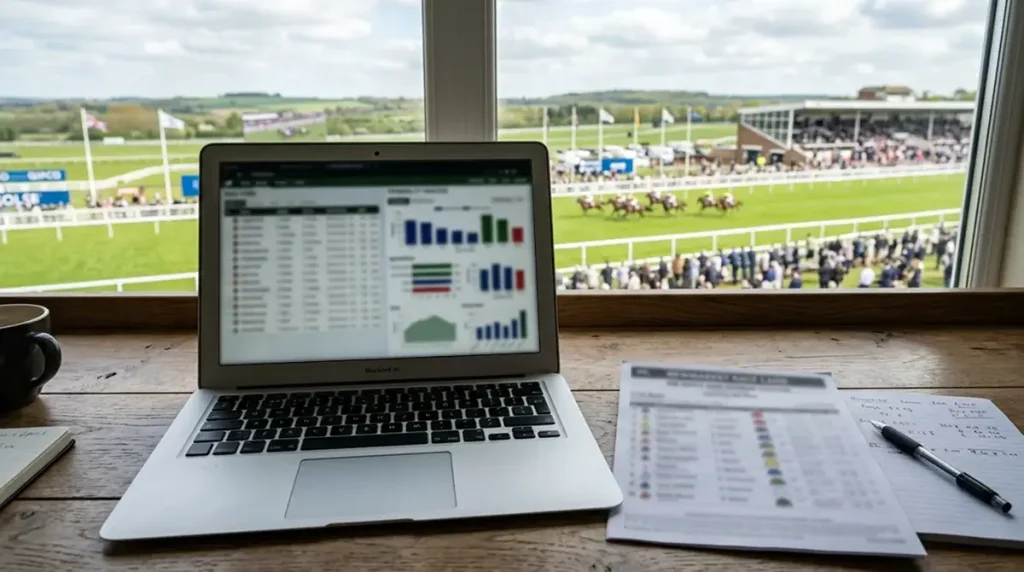
A friend of mine spent six months building a machine learning model to predict horse racing outcomes. He fed it ten years of form data, going conditions, trainer records, and jockey statistics. The model’s first month of live testing produced a 3% ROI. Its second month produced a minus 8% ROI. By month four, the cumulative return was essentially flat — no better than random selection at bookmaker odds. He shut it down and went back to reading the form book. His experience mirrors what I have seen across the growing intersection of AI and horse racing: the technology is real, the hype outpaces the results, and the most important question for any punter is whether AI makes the market harder or easier to beat.
The global AI sports betting market is projected to expand from 10.8 billion dollars in 2025 to more than 60 billion dollars by 2034. That growth is driven by institutional adoption — bookmakers and exchanges using AI internally — as much as by retail products marketed to punters. Understanding the difference between the two is essential before you decide whether to buy, build, or ignore AI tools.
How Bookmakers Use AI to Set and Adjust Odds
Betfair UK implemented predictive AI for its odds compilation in 2025, and the headline result was a 28% reduction in settlement delays. That number tells you more about where AI excels in horse racing than any marketing pitch: it is not primarily about picking winners. It is about processing data faster and more consistently than human traders can manage.
Modern bookmaker pricing starts with algorithmic tissue models. These models ingest form data, trainer-jockey statistics, going preferences, and historical patterns to produce an initial set of odds for every race. Human traders then adjust those odds based on market intelligence, customer behaviour, and qualitative factors the algorithm cannot capture — stable rumours, visual assessment of horses in the paddock, the weight of money from sharp accounts.
The AI component accelerates the data-processing layer. Instead of a trader manually reviewing 15 runners’ form and cross-referencing going records, the algorithm does it in seconds and produces a probability estimate for each horse. The trader’s role shifts from data processing to judgment — applying context that the model cannot quantify. The online horse racing platform market was valued at 360 million dollars globally in 2025 and is growing at 4.3% annually, and a significant share of that platform investment goes into AI-powered pricing systems that give operators faster, more granular odds compilation.
For punters, the implication is clear: the market is becoming more efficient. AI-assisted pricing narrows the window of opportunity for human bettors who rely on spotting obvious form misreads. The easy edges — the horse that clearly loves soft ground but is priced as if the going does not matter — are being closed faster than ever because the algorithm catches them automatically. The surviving edges require subtler analysis or access to information that the models do not incorporate.
AI Tools Available to Punters: What Works and What Does Not
The retail AI betting market is crowded with products that promise data-driven selections, and the quality varies from genuinely useful to outright useless.
At the useful end: tools that aggregate and visualise data. Applications that compile form, speed figures, trainer-jockey combinations, and going history into a single dashboard save enormous amounts of time compared to manual analysis. These are not predictive in the meaningful sense — they do not tell you who will win. They present the data that helps you make better decisions. I use two such tools regularly, and they have genuinely improved my workflow by allowing me to screen 30 runners in five minutes rather than 30.
At the questionable end: “AI tipster” services that charge subscription fees for daily selections generated by proprietary algorithms. The problem with these services is transparency. You cannot evaluate a black-box model without understanding its inputs, its logic, and its historical performance under controlled conditions. Most services publish selected highlights — their winners — while burying the losing runs that any model inevitably produces. Without verified, audited records over statistically significant sample sizes (hundreds of bets minimum), these services are impossible to distinguish from coin flips dressed in machine-learning jargon.
My advice to any punter considering an AI tool: ask for the full, unedited record of every bet the system has recommended over a minimum of six months. If the vendor cannot or will not provide it, the product is not worth your money.
Whether AI Makes the Horse Racing Market More Efficient
The average per-race turnover has dropped 15% compared to 2022-23 and 19% compared to 2021-22. Meanwhile, AI adoption among operators has accelerated. The conjunction of these two trends raises a question that matters for every serious punter: has AI made the market so efficient that beating it is no longer possible?
The honest answer is: partially. Andrew Rhodes, the Gambling Commission’s chief executive, has pointed out that online betting follows the pattern of large marquee events and that the statistics show a return to the previous norm rather than a decline. Translated to market efficiency: the biggest, most liquid markets — festival races, Saturday features, major handicaps — are priced with increasing precision because they attract the most sophisticated money and the most AI-assisted analysis. Finding value in a Cheltenham Gold Cup market is measurably harder than it was five years ago.
The smaller markets are a different story. A Tuesday evening meeting at Catterick, with a thin pool of form data and minimal algorithmic scrutiny, still contains pricing inefficiencies that a knowledgeable human can exploit. AI models trained on vast historical datasets perform best where the data is deepest — elite racing with well-documented form. They perform worst where the data is sparse, incomplete, or requires contextual interpretation that algorithms cannot replicate: first-time runners, horses switching codes, races on unusual ground conditions, or fields dominated by unexposed horses with limited form profiles.
The market is becoming more efficient at the top and staying messy at the margins. For the punter willing to operate in those margins — to study the cards that the algorithms treat as low-priority — there are still genuine opportunities to find prices that overstate a horse’s probability of losing. AI has not killed human edge in horse racing. It has relocated it. For a structured approach to identifying the overpriced selections that still exist in this environment, the systematic framework for value betting outlines the method.
Are AI horse racing predictions more accurate than traditional tipsters?
Not consistently, based on the evidence available. AI models excel at processing large volumes of form data quickly and identifying statistical patterns, but they struggle with contextual factors — paddock assessment, stable intelligence, unusual ground conditions — that experienced human analysts incorporate intuitively. The best approach is probably a hybrid: use AI tools for data processing and screening, then apply human judgment for the qualitative factors the model cannot capture.
Which UK bookmakers use AI to set horse racing odds?
Most major UK operators now use some form of algorithmic pricing assistance. Betfair"s implementation of predictive AI in 2025, which reduced settlement delays by 28%, is the most publicly documented example. Other large operators including those within the Flutter and Entain groups use proprietary models for initial tissue pricing, with human traders adjusting the output. The exact methods are commercially sensitive and not publicly detailed.
Articles
Written by the editors at Betting Online Horse Racing.
